Commercial cleaning for Mulberry workplaces, scoped in writing.
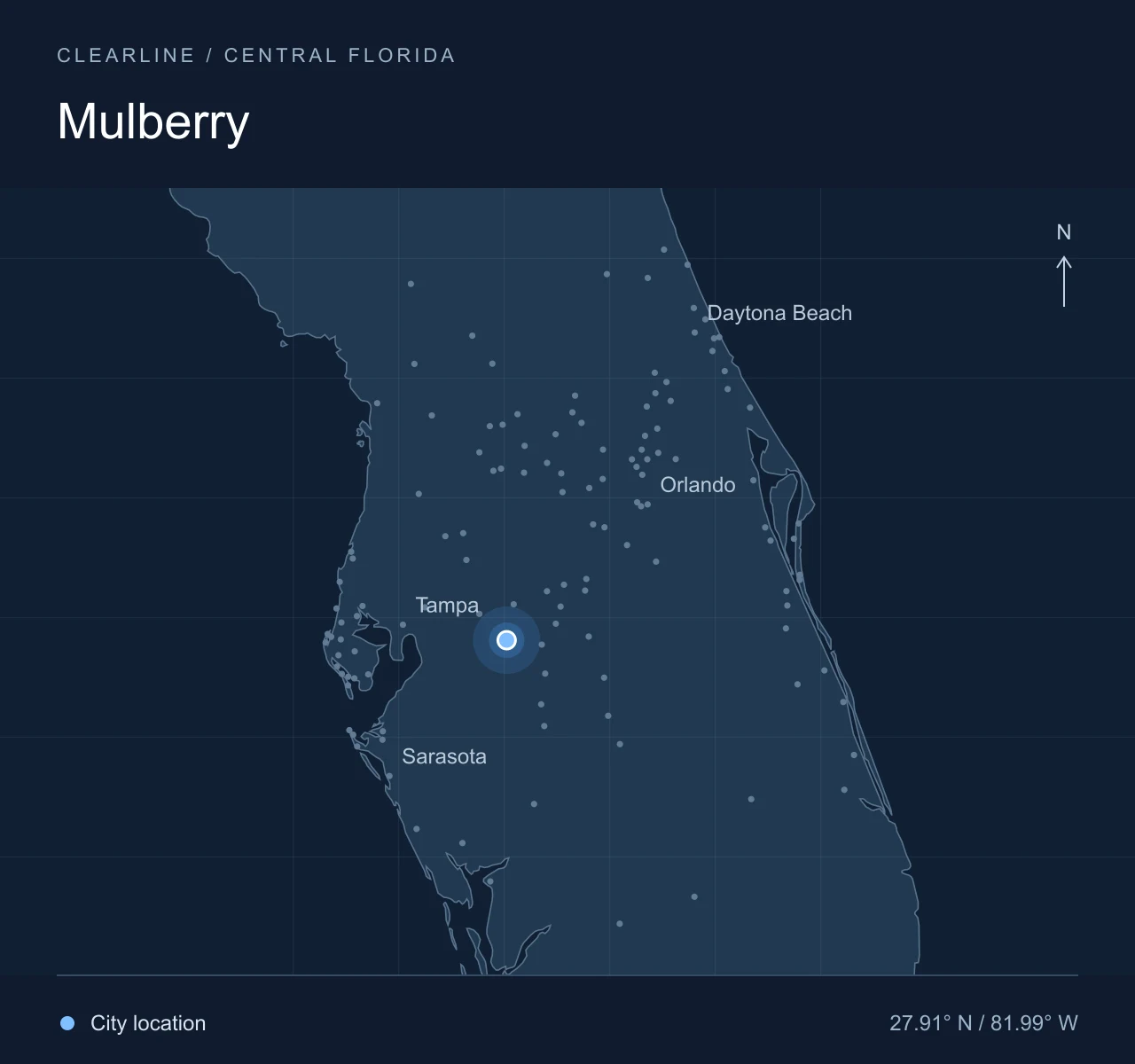
We come to Mulberry from our base in Davenport, on the other side of Polk County. The buildings here are a mix we know well: offices attached to yards and plants, storefronts downtown, and public buildings that see the whole town. Before any work starts, we walk your building with you and put the scope in writing. Then the same crew comes back each visit, and the owner stays involved in how the work is done. You know who is responsible, and what they agreed to.
Serving MulberryFacility care in Mulberry, built around your operating hours and cleaning priorities. We confirm your scope and preferred service schedule during the walkthrough.Regional location diagram. Geography: Natural Earth · City points: U.S. Census Gazetteer.
Local context
What is changing in Mulberry right now
Mulberry's redevelopment agency, formed in 2016, puts about $1.8 million a year into downtown and into grants for small businesses. That money has already opened Depot 303, a 14,000-square-foot food hall, and drawn a concrete company's fourth location to the city's industrial park. Newer buildings like these have owners and tenants who are still deciding who cleans the shared spaces. That is the first thing we sort out on a walkthrough.
The city is also financing a new municipal complex with a city hall, a cultural center and museum, and a police substation. Public buildings run on public hours, and a lot of people pass through the lobby. In phosphate country, with employers like Mosaic and CF Industries nearby, plenty of offices sit next to a yard or a plant, and the dust comes in on boots. We'll ask which doors matter most and plan the scope around them.
The buildings we expect to see in Mulberry
Offices inside the industrial park
A concrete supplier, a contractor, or a rail-side shipper usually has a small office up front and a big operation out back. The office is where customers and drivers check in, and it takes a beating from the yard. The scope names the office rooms, the break room and the restrooms, and states that the yard and shop floor are excluded unless you ask. Grit control at the entrance goes at the top of the list.
Downtown storefronts and food-hall tenants
A CRA grant can put a new front on a shop, and then someone has to keep the glass clean. Restaurants and small retailers downtown share hallways, restrooms and back-of-house corridors with their neighbors. We look at what your lease makes you responsible for, and we write the scope around that line rather than around the whole building.
City and public-service buildings
A city hall, a museum or a police substation has a lobby the public uses all day and offices behind a door the public never sees. We separate the two in the scope, with the public side on a tighter rhythm and the staff side on the schedule that suits the department.
What the written scope covers in Mulberry
The scope lists each room, the tasks in it, how often, and what is not included. It says which supplies we bring, what stays yours, and the service window that fits your hours. For an office in the industrial park, that might mean the front office and restrooms nightly and the break room each visit, with the shop excluded. For a downtown storefront, it might be the sales floor and entrance glass after closing, three nights a week. A public building might have its lobby and restrooms daily and the back offices twice a week. No agreement is a copy of another one.
Our recurring janitorial page describes the day-to-day work, and our services page covers floors, restrooms and turnover cleaning.
First we walk the building together, with the owner there, and you show us what matters. We write the scope from that walk and send it to you to check. When you agree, we settle a schedule that fits your hours. After that, the same crew returns to your building each visit, and the owner stays close to the work instead of passing it along. When something changes, a new tenant or a new wing, the scope is rewritten so it still matches the building.
What a walkthrough in Mulberry covers
In an office attached to a yard, the walkthrough starts at the door the drivers use, because that is where the grit arrives. We follow the path to the counter, the restrooms and the break room, and we ask where the shop ends and the office begins. Downtown, it starts at the glass and the entrance mat. In a public building, we ask what hours the lobby is open. Those answers become the first lines of the scope.
A space being turned over between uses. Illustrative image, not a Mulberry job.
Questions we hear in Mulberry
Our office is in the industrial park, next to a working yard. Will you take that on?
Yes. The office side is what we scope: front office, restrooms, break room and the entry where drivers come through. The yard and any shop floor stay out of the agreement unless you ask us to include them. We plan for dust from the start, because in Mulberry it is a given.
We are a downtown tenant. Do we need the landlord involved?
Only if the lease puts shared hallways or restrooms on the landlord's side. We ask about that on the walkthrough and write the scope around the areas you actually control. If the landlord wants the common areas covered too, that becomes a separate conversation with them.
Do we have to sign a long-term contract?
No. We work from a written scope and an agreed schedule, not a multi-year contract. If your needs change, the scope changes with them. We can also provide a certificate of insurance, the document from our insurer showing our coverage is in force, when your building requires one.