Commercial cleaning for Haines City workplaces, scoped in writing.
We come to Haines City from our base in Davenport, a few minutes up the road. The buildings here are different from ours: production plants, distribution centers, a large new retail center and an old downtown with its own storefronts. Before we start, we walk your building with you and put the rooms, tasks and schedule in a written scope. The same crew returns each visit, and the owner stays involved in the work. You know who is responsible, and what they agreed to.
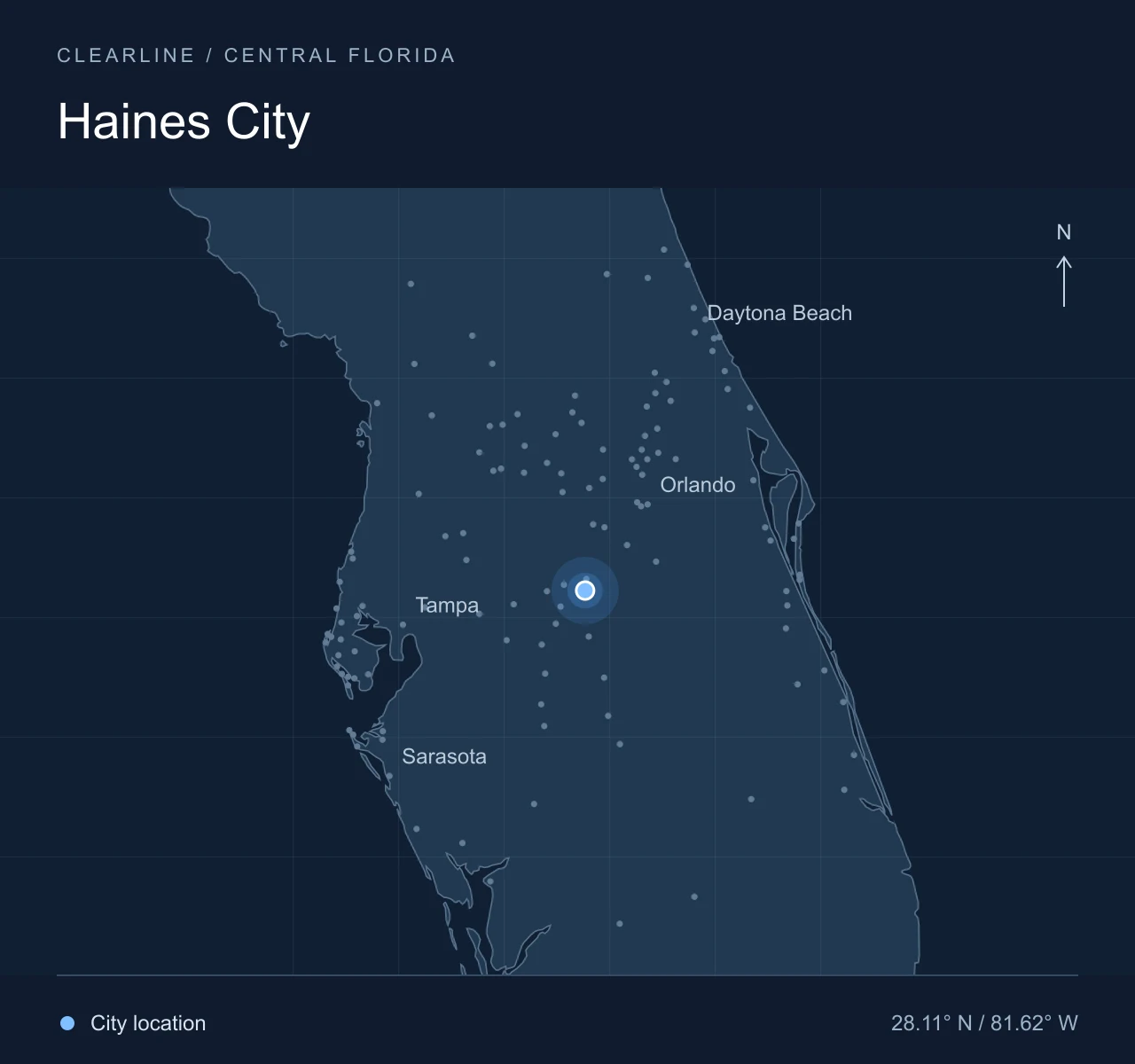
Serving Haines CityFacility care in Haines City, built around your operating hours and cleaning priorities. We confirm your scope and preferred service schedule during the walkthrough.Regional location diagram. Geography: Natural Earth · City points: U.S. Census Gazetteer.
Local context
What Haines City buildings ask of a cleaning crew
Haines City Industrial Park added five new or expanded operations in 2025, about $193 million of construction, including a 29,000-square-foot Sika plant, a Restaurant Depot warehouse and a 174,000-square-foot wood products facility. Plants like these run in shifts, so the office side, break rooms and restrooms are busy at hours that don't match a nine-to-five service window. We'll ask when the floor is quiet and who signs the crew in.
At the other end of town, Crossroads Village Center is bringing 320,000 square feet of retail and restaurant space to the corner of US 27 and US 17-92, with a first phase expected in summer 2026. New tenants there will need a scope written before the fixtures arrive. Downtown, the CRA offers facade grants to commercial owners, and a renovated storefront changes what needs attention: new glass, new floors, new restrooms. We'll discuss what changed and what it takes to keep it that way.
Building types we plan for in Haines City
Offices inside plants and distribution centers
In a manufacturing or food-distribution building, the office side is the part visitors and applicants see. Front office, conference room, locker rooms, break rooms and restrooms are ours. The production floor and any food-grade areas are not, and the scope says so plainly. We ask about shift changes so the break room is done between them, not during.
Retail and restaurant back-of-house
A junior anchor or restaurant in a new center has a public face the tenant's own staff handle every day, and a back-of-house nobody has time for. Staff restrooms, office, stockroom floors and employee break areas fit a written scope well. We look at delivery hours and the alarm routine before we set a service window.
Downtown storefronts and small offices
Older buildings on the downtown blocks have wood or tile floors, storefront glass facing the sidewalk and one restroom that everyone shares. We write the scope around those three things and the hours you are open. Weekly or twice-weekly visits are common for this kind of space.
What the written scope covers
The scope names each room, what happens in it, how often, and what is excluded. It lists the supplies we bring, what you provide, and the service window we agreed on. For an industrial-park office that might mean the lobby, offices and restrooms five nights a week, break rooms daily between shifts, with the production floor excluded. For a downtown storefront, glass and floors twice a week, restroom every visit. For a retail tenant, back-of-house only, after the last delivery. Nothing is assumed to be included; it is in the scope or it isn't.
Our recurring janitorial page describes the day-to-day work, and our services page covers floors, restrooms and turnover cleaning.
First comes the walkthrough, with the owner, at your building. We ask about hours, access and the rooms that matter most to you. Then we write the scope and send it over for you to read and change. When you agree, we set the schedule and the service window. After that the same crew comes to your building on each visit, and the owner stays close to the work. When your building changes, a new tenant, a new shift, a renovation, the scope changes too, in writing.
What a walkthrough in Haines City covers
In an industrial-park building we start at the employee entrance, not the front door, because that's the path most people use. We look at the break room, the locker-room restrooms and the office corridor, then ask where the line is between office and floor. In a storefront we start at the sidewalk glass and the entry mat. Either way, we note what you point at and put it at the top of the scope.
The office and break areas inside an industrial building. Illustrative image, not a Haines City job.
Questions we hear in Haines City
Our building is in the industrial park with shift work. Can you clean between shifts?
Usually, yes. Plants and distribution centers in the park run on hours that don't match an office schedule, so the walkthrough settles when the break room and restrooms are free. The scope names the service window and who lets the crew in. We don't promise a specific window before we've seen the building.
We are opening in Crossroads Village Center. When should we call?
Before the fixtures arrive, if you can. A new retail or restaurant space usually needs a first cleaning after construction and then a regular scope for back-of-house. Walking it empty lets us write both, and the scope is ready when you open.
Do you require a long-term contract?
No. We work from the written scope and the agreed schedule, not a multi-year agreement. If something isn't working, we talk about it and adjust the scope in writing. We can also provide a certificate of insurance, or COI, when your landlord or property manager asks for one.